Science + Possibility + Service

The Science of Recovery.The Development of Human Performance.

Applied biomechanics connects them.

Applied biomechanics helps reveal how movement limitations and compensations may be contributing to pain, incomplete recovery, or reduced performance. A whole-body biomechanics assessment identifies the relationships most relevant to you. From there, we work together through an individualized movement program—guided by the principles and strategies of applied biomechanics—to support recovery, restore mobility and balance, build strength, and improve performance in life and sport.

Individualized by design

Biomechanics for recovery, performance, and life.

Your rehabilitation, movement, strength, or sport-performance program should begin with what your biomechanics assessment reveals—not with a predetermined collection of exercises.

The process begins by understanding how the feet, ankles, knees, hips, pelvis, trunk, shoulders, and nervous system work together. We look for where useful motion and force are available, where they may be lost or redirected, and where the body may be compensating to accomplish the task.

Those findings guide the creation of a biomechanics-based program that may combine movement restoration, rehabilitative exercise, strength development, and sport-specific preparation. The goal is not simply to change an isolated body part. It is to improve the relationships that allow the entire person to move, recover, and perform more effectively.

ASSESS THE SYSTEM → IDENTIFY THE RELATIONSHIPS → BUILD THE INDIVIDUAL STRATEGY

Understanding compensation

Compensation is an adaptive option—not necessarily a correction.

The human body is remarkably resourceful. When one movement option is limited, uncomfortable, or unavailable, another part of the system often contributes more so the task can still be accomplished. A broader view helps us distinguish a contributing factor from a compensation—and an effect from a possible cause.

AdaptThe body finds another way.
RepeatThe strategy becomes familiar.
AccumulateThe trade-off may become costly.

Compensation is not automatically the enemy.

It may help the body continue moving when another movement option is limited, uncomfortable, or unavailable. In that moment, it can be a useful problem-solving strategy—but it often involves a trade-off. When the same strategy is repeatedly required, it may increase demand elsewhere, reduce movement efficiency, limit performance, or contribute to recurring symptoms.

Pain may return. Tightness may persist. Progress may stall. A person may become stronger while still moving around the same underlying limitation.

The goal is not to assume that every compensation must be eliminated. It is to determine which compensations may be temporarily helpful, which have become costly, and what movement options should be restored so the body can access more of its available resources.

Why this approach works

More than muscles.

Training changes the information the nervous system receives, the forces the fascial network distributes, and the movement options the body can access.

The nervous system organizes

Every movement provides information about position, direction, speed, balance, pressure, and load. Purposeful variability challenges perception, coordination, motor learning, and the ability to adapt—not merely muscular effort.

Explore movement and brain plasticity →

Fascia connects

Fascia is more than packaging around muscles. It is a continuous, adaptable, sensory-rich connective-tissue network involved in force transmission, proprioception, elastic response, and coordination across the body.

Explore fascia and biotensegrity →

The whole system adapts

Muscles, joints, connective tissues, sensory information, neural pathways, and movement strategies adapt together. Effective training respects these relationships and the person, task, and environment in which movement occurs.

Explore strength as a whole-system capability →

3DMAPS®

66

Three-plane joint motions observed within an integrated human system.

  • 6 Vital Transformational Zones
  • 6 Chain Reactions®
  • Movement quality and range
  • Stability and control
  • Multi-angle video analysis
  • Individual response to change

Why assessment comes first

If you are not assessing, you are guessing.

The 60–90-minute biomechanics assessment uses Applied Functional Science and the Gray Institute’s 3DMAPS® system to examine how your body moves in three dimensions and manages force.

Your video assessment allows movement to be slowed down and reviewed from multiple angles rather than judged only in real time. Selected movements can then be adjusted and repeated to reveal how your system responds—not simply where it appears limited.

  • Where is useful motion available?
  • Where does motion become limited or poorly controlled?
  • How is force being accepted and distributed?
  • Where may the body be compensating?
  • What changes when position, direction, range, or speed changes?

Assessment reveals possibility.™

Request an Assessment

A systems-based view of recovery

Healing is a Chain Reaction.

Through appropriate movement, sensory information, progressive loading, recovery, and repetition, we can help create an environment in which healing and adaptation are more likely to occur.

That environment may require restoring motion, improving sensory information, progressively introducing load, developing strength, rebuilding confidence, and helping different regions of the body share force more effectively.

A painful tissue deserves local attention. But lasting recovery may also depend upon what is happening above it, below it, and throughout the rest of the system. A shoulder may need better contributions from the thoracic spine, pelvis, and hips. A knee may need the foot and hip to receive and redirect force more effectively. A painful back may be compensating for movement that is unavailable elsewhere.

When one part of the body changes, the demands placed upon other regions also change. In that sense, healing is not merely a local event.

Create the environment.
Let the system adapt and heal.

What I do

From understanding to purposeful application.

Recovery, strength, and performance are different expressions of the same human system. I use a principles-based process grounded in human biomechanics, then adapt the strategy to the individual, the task, and the goal.

Biomechanics-Based Rehabilitation

Individualized programs for recurring pain, persistent tightness, movement limitations, and incomplete recovery.

Movement Restoration

Restore motion, coordination, sensory awareness, force management, and confidence across the kinetic chain.

Strength & Human Performance

Build capacity while respecting authentic movement, progressive loading, adaptation, and the individual response.

Sport-Specific Performance

Apply the framework to the movement and force demands of golf, tennis, running, hockey, lifting, and other meaningful activities.

Three-dimensionalSagittal · frontal · transverse
Whole-personHistory · goals · capability
Task-specificThe movement must serve its purpose
Context-dependentPosition · environment · speed · load
ProgressiveMobility · stability · force · confidence

The process

Understanding becomes capability through progression.

Each stage builds on what your body reveals. The process remains adaptable because the individual response—not a predetermined protocol—guides the next decision.

1

Assess

Create a three-dimensional picture of current movement and force management.

2

Understand

Translate findings into clear, practical information the client can use.

3

Develop

Select strategies and techniques appropriate to the individual.

4

Integrate

Connect newly available motion and control to meaningful activity.

5

Adapt

Progress range, direction, speed, load, and complexity according to response.

6

Build Self-Efficacy

Develop the understanding and confidence to care for the body beyond the program.

The culmination of decades of study and practice

Understanding changes what becomes possible.

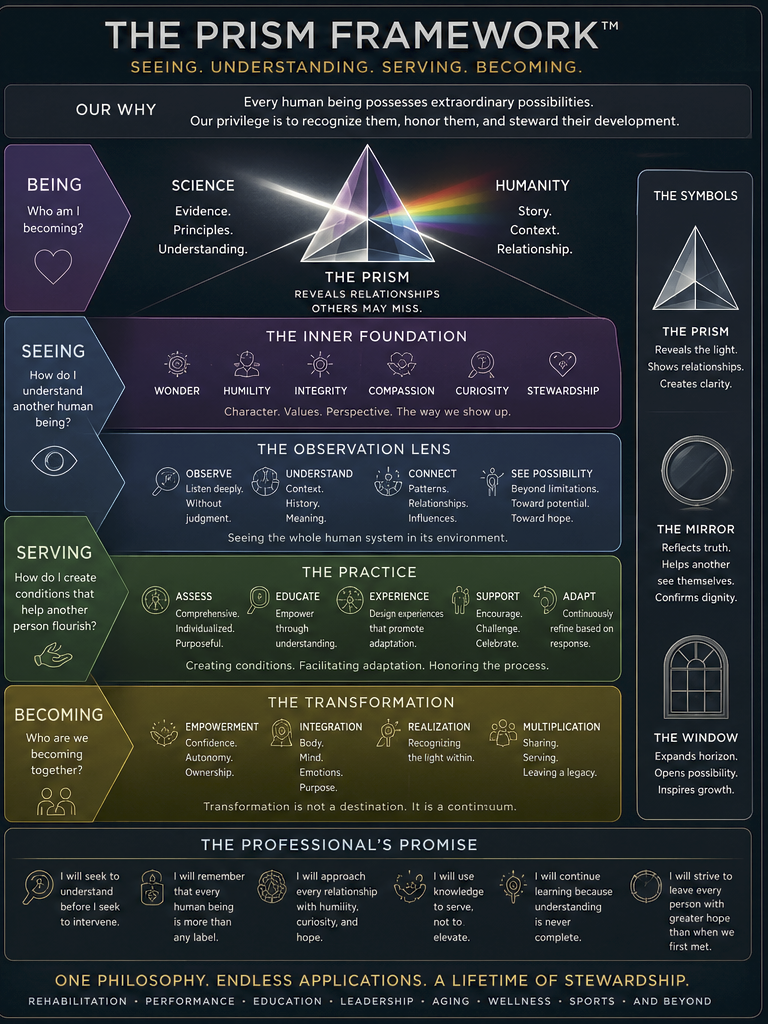
The Prism Framework™ brings together more than 35 years of study, teaching, and application across exercise physiology, kinesiology, psychology, neuroscience, biology, biomechanics, rehabilitation, strength and conditioning, and Applied Functional Science.

Each discipline reveals something important. None explains the whole person by itself. The framework organizes these perspectives into a more complete way of seeing—so movement can be understood in relationship and individualized experiences can be designed with greater purpose.

See → Understand → Design → Adapt → Develop

It is not another collection of exercises or a rigid protocol. It is a way of observing, reasoning, teaching, and serving. The more completely we see the person, the more intelligently we can design the experience.

The Prism Framework map showing Being, Seeing, Serving, and Becoming

How the Center helps

From limitation toward capability.

I created the Applied Biomechanics & Human Performance Center to help people better understand persistent pain, recurring injuries, movement limitations, and the factors that may be restricting their progress. Through whole-body assessment and individualized movement programs, I help active adults and athletes improve how their bodies move and manage force—developing the mobility, balance, strength, agility, and power required for life and sport.

Pain and recurring symptoms

Explore whole-body movement relationships that may contribute to repeated stress or compensation.

Return to activity

Progress from protected movement toward walking, lifting, golf, tennis, travel, work, and daily life.

Movement limitations

Develop mobility and stability together rather than treating them as unrelated qualities.

Performance

Improve how the body accepts force, adapts to changing demands, and expresses strength in context.

Durability and aging capably

Prepare the body before a limitation becomes a crisis and preserve participation over time.

Education and self-efficacy

Learn how to use and adapt exercises selected for your biomechanics and the specific demands of your life or sport—giving you practical tools that remain useful as your body and goals change.

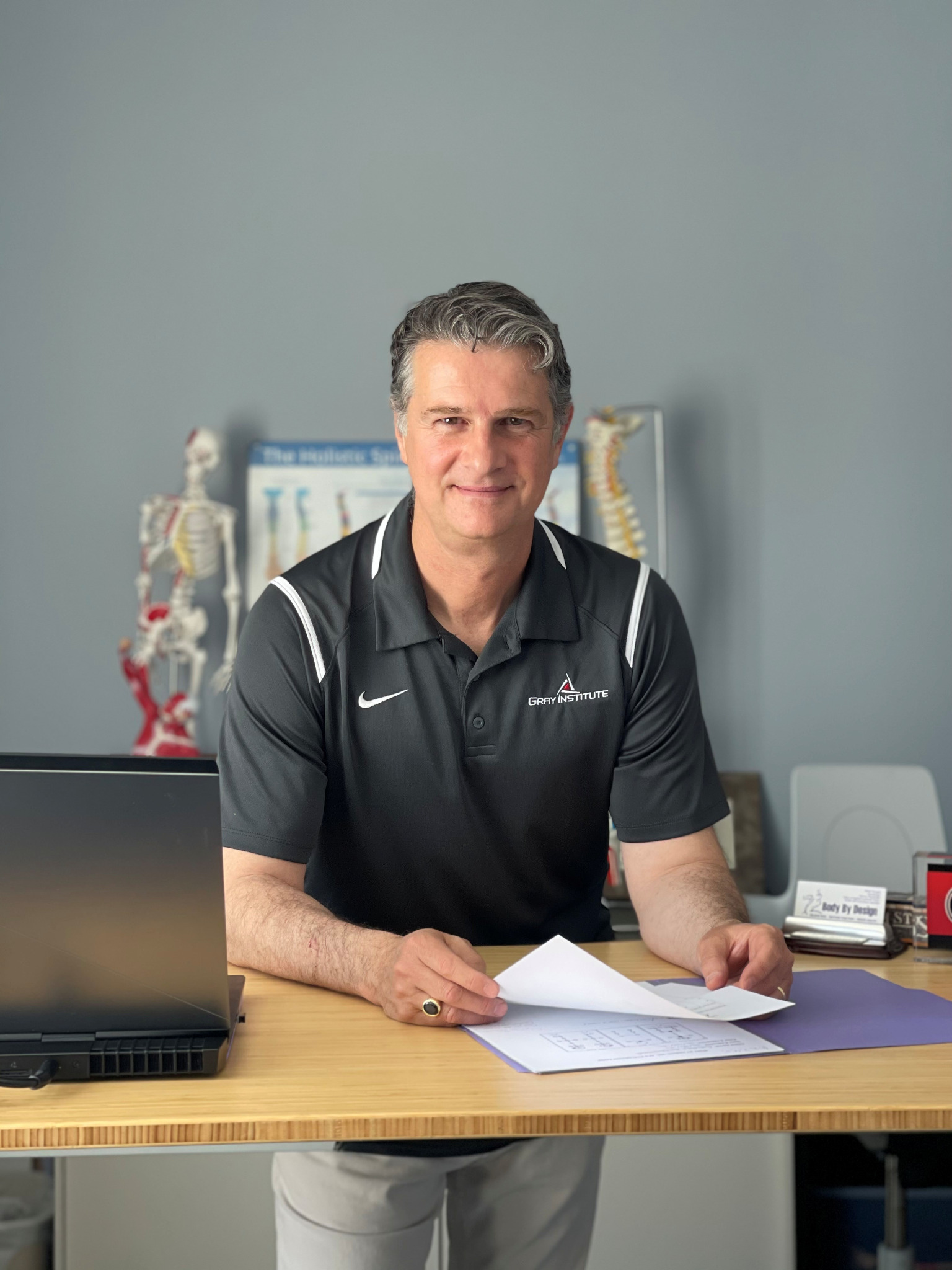
Bob Fanelli in his biomechanics office

Meet Bob

Bob Fanelli, MSc, FAFS

Exercise Physiologist · Kinesiologist · Fellow of Applied Functional Science

35+ yearsApplied biomechanicsMovement educationFormer Gray Institute faculty

For more than 35 years, Bob Fanelli has studied how the human body moves, adapts, compensates, rehabilitates, and performs. His work integrates exercise physiology, kinesiology, applied biomechanics, and Applied Functional Science.

For a decade, Bob was blessed to teach under and alongside Dr. Gary Gray and Dr. Dave Tiberio through the Gray Institute’s Applied Functional Science program. During that time, he taught more than 1,500 professionals from over 27 countries—including physical and occupational therapists, physicians, osteopaths, personal trainers, and strength and conditioning coaches working in collegiate and professional sport.

His role is not to make clients dependent upon him. It is to help them understand their bodies, participate in the process, and develop the confidence and capability to care for themselves more effectively.

Begin a Conversation

Professional collaboration

A systems-based movement resource for professionals.

The Center welcomes collaboration with physicians, functional-medicine practitioners, nurses, physical therapists, chiropractors, pelvic-health professionals, coaches, trainers, and other allied professionals.

The Center contributes a movement perspective: observing how a person moves and manages force, developing an individualized strategy, and communicating relevant findings when collaboration is appropriate and authorized.

This work can complement medical, rehabilitative, and wellness care for people whose symptoms, limitations, or performance concerns may not be fully understood by examining one region in isolation.

Begin a Professional Conversation

What clients experience

Understanding that extends beyond the session.

Every person and program is different. Yet clients often describe a shared experience: clearer understanding, renewed confidence, and practical tools that help them participate more fully in their own recovery and development.

Bob, I can’t tell you how much I enjoy our sessions. The information I am learning is invaluable and having a gentle soul offering it with so much love and patience is magical.
Tania
You have an amazing talent of shining a bright light on the road ahead—a road that may seem dark when one’s body is in pain or stuck in some way. I know now to trust the process, and I understand that when something feels stuck or I am in pain, there is always a way out.
Jessica
Bob’s assessment is extremely thorough, insightful, and telling of what his personalized program might entail for you. He’s professional, kind, filled with knowledge, and you can tell without question that he absolutely loves what he does and enjoys teaching biomechanics if you ever wonder why you’re doing a movement and how it relates to your needs.
Gina

The next step

Begin with understanding.

If you are dealing with recurring pain, movement limitations, difficulty returning to activity, or a performance concern that has not been fully resolved, the most appropriate first step is a biomechanical assessment.

bbd@bbdinfo.com · Currently located at AltaFit, 5 Plain Avenue, New Rochelle, New York
In-person and selected remote consultations are available when appropriate.