A more complete way of seeing
The Prism Framework™
An interdisciplinary philosophy and applied system for seeing, understanding, and serving the human being more completely—so individualized experiences can create the conditions for adaptation, expanded capability, and lifelong participation.
The origin
The culmination of decades of study, teaching, and practice.
Each discipline reveals something important. None explains the whole human being by itself.
The Prism Framework brings together more than 35 years of study and application across exercise physiology, kinesiology, psychology, neuroscience, biology, biomechanics, rehabilitation, strength and conditioning, and Applied Functional Science.
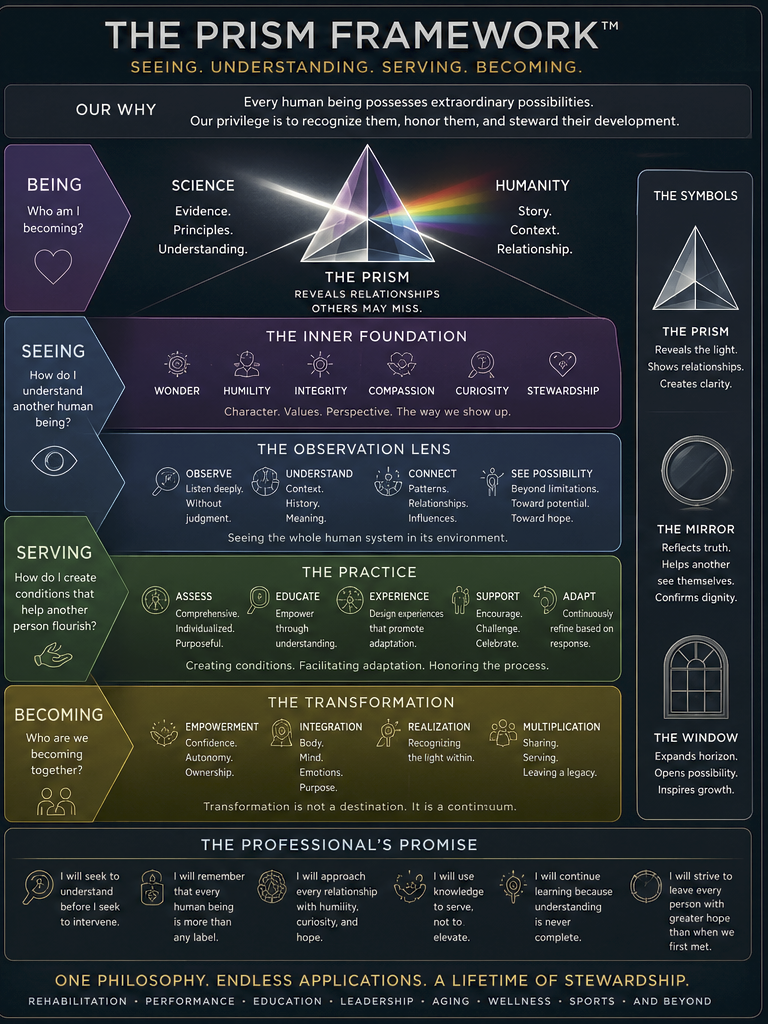
Like light entering a prism, information becomes more meaningful when its relationships are revealed. The framework exists to organize those perspectives—not to replace them—and translate understanding into individualized service.
The purpose
Understanding the human system. Developing human potential.
The framework does not promise perfection. It promises a more complete way of seeing.
People often arrive believing they have several unrelated problems: a painful foot, a tight hip, an unreliable back, or a shoulder that never fully recovered. The Prism Framework asks what relationships may connect those experiences and how the person’s history, environment, goals, and adaptations influence the present.
It does not begin by imposing a technique. It begins with curiosity, observation, and respect for the intelligence of the human system.
The purpose is not to create potential for another person. It is to help reveal capabilities and possibilities that may not yet have been recognized or fully expressed.
Foundational beliefs
What guides the work.
The applied method
From seeing to development.
The framework turns philosophy into a repeatable but individualized process.
Principles → Strategies → Techniques
Principles help explain how humans function. Strategies organize those principles around the individual. Techniques are selected, modified, sequenced, and progressed according to the response. The technique may change. The principle remains.
A human experience
Why the explanation often feels immediately recognizable.
When the body is explained through its relationships, the explanation often makes sense because it reflects how the human system actually functions.
Clients frequently say that they have never heard their bodies explained this way. The difference is not a secret technique. It is the willingness to connect information that is often taught and treated separately—and to translate that complexity into language a person can understand and use.
Understanding reduces mystery. It creates better questions, more informed choices, and greater confidence in the process.
Science + Possibility + Service
A framework should help people move forward.
The Prism Framework comes to life through assessment, rehabilitation, performance development, education, professional collaboration, and the continuing process of helping people understand and care for themselves more effectively.